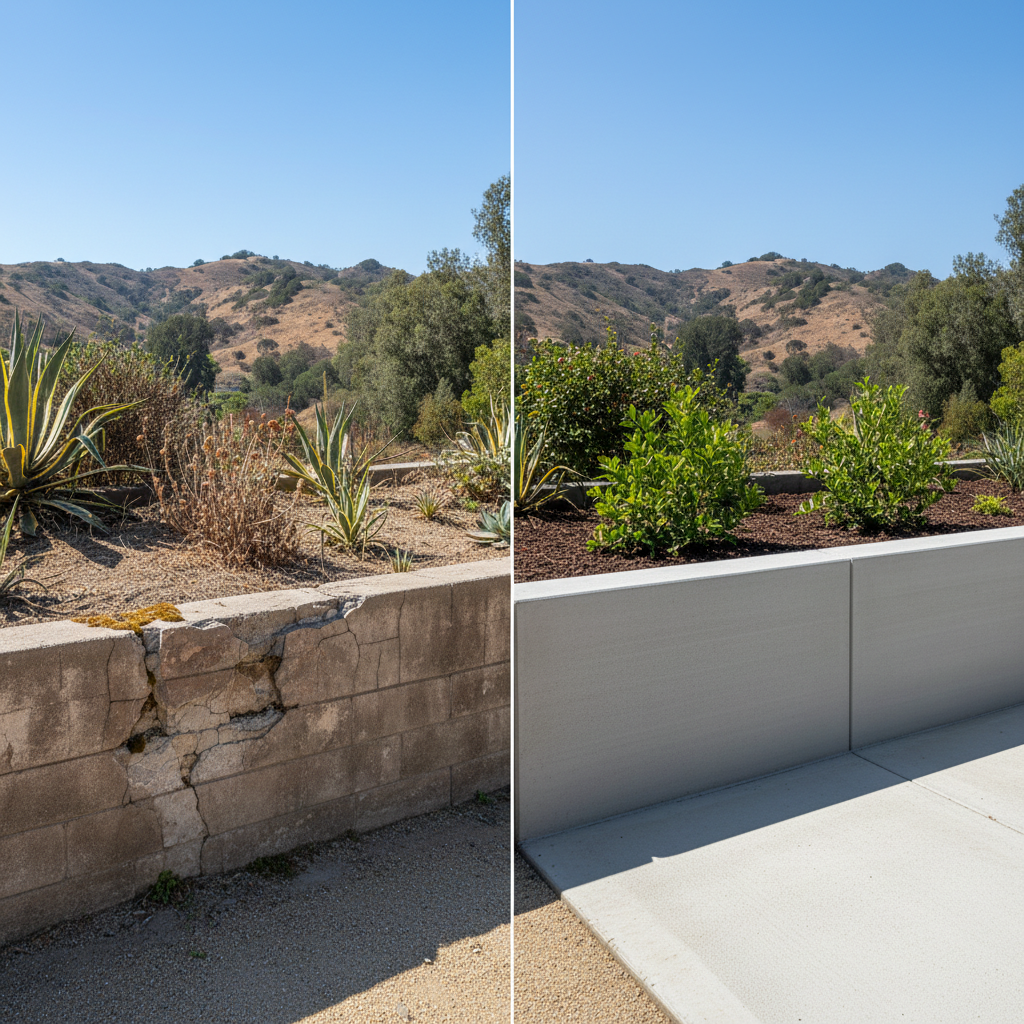
Alright, let's talk about retaining walls. Got a slope? Need to hold back some earth? Or maybe you're just dreaming of a tiered garden. Whatever your reason, concrete's probably on your mind, and that's a smart move. But then you hit the classic dilemma: should you go with a solid, poured concrete wall, or stack up some concrete blocks? It's a question I hear all the time, and I've seen both types done beautifully — and, frankly, not so beautifully — across Ventura, from the steep hillsides of Ondulando to the flatter areas near the beach.
Poured Concrete Retaining Walls: The Heavyweight Champ
When I talk about 'poured concrete,' I mean a wall that's built right there on your property. We typically set up forms, lay down rebar for strength, and then fill it with wet concrete. It hardens into one strong, solid piece. Think of it like a miniature dam, holding back the soil.
Pros:
- Seriously Strong and Long-Lasting: This is the big one, no doubt about it. Poured concrete walls are incredibly tough. They're designed to handle a lot of side-to-side pressure, which is super important here in Ventura, especially when those heavy rains hit and the soil gets all saturated and heavy. They're much less likely to shift or bow over time, assuming, of course, they're engineered and put in correctly.
- Built to Last: These walls are practically generational. They don't rot, bugs don't care for them, and they're fire-resistant. You're looking at 75 to 100 years, maybe even more, if they're installed right and you give them minimal upkeep.
- Flexible Design Options: You can really get creative with poured concrete. We can add curves, steps, and even stamp or color the surface so it really blends with your home's look. It just looks so smooth.
- Low Upkeep: Once it's in, you pretty much forget about it. You might hose it down now and then, but structural maintenance? That's almost never an issue.
Cons:
- Higher Initial Cost: This is usually where people pause. Poured concrete needs more labor, formwork, and special equipment. It's an investment, absolutely.
- Takes Longer to Install: There's a whole process involved: digging, placing rebar, setting up forms, pouring the concrete, and then waiting for it to cure. It just takes time.
- Not a DIY Project: Unless you're a seasoned concrete pro, this isn't something you can knock out on a weekend. You need real expertise to make sure the engineering, drainage, and structural integrity are all spot on.
Concrete Block Retaining Walls: The Modular Solution
Concrete block retaining walls, sometimes called segmental retaining walls (SRWs), are made from individual blocks that interlock. They hold back the soil using their own weight, how they connect, and often a geogrid reinforcement system.
Pros:
- Lower Price Tag: Generally, block walls cost less than poured concrete. The materials are cheaper, and the labor can be less intense, especially for smaller, simpler walls.
- Quicker Installation: Since you're just stacking pre-made blocks, the whole thing can go up faster than waiting for concrete to cure.
- DIY Potential (for smaller walls): For low walls that aren't holding back anything too critical, a handy homeowner might actually be able to tackle a block wall. But for anything substantial or structural, you absolutely need professional help.
- Easier to Fix: If a section gets damaged, it's often simpler to swap out a few individual blocks than to repair one big, solid poured wall.
Cons:
- Less Strength for Big Jobs: Don't get me wrong, block walls are strong, but they usually don't have the sheer, monolithic strength of a poured concrete wall. For really tall walls or those holding back a lot of weight, they need a ton of engineering and reinforcement, which can quickly erase any cost savings.
- Drainage is Key: These walls are often designed to let some water through. So, making sure there's proper drainage behind the wall is absolutely crucial. Otherwise, water pressure can build up and push them right over.
- Looks Can Be Limited: Sure, block makers offer different colors and textures, but that segmented look isn't for everyone. It can sometimes look a bit more... blocky, if you know what I mean.